

We may earn money or products from the companies mentioned in this post.
Featured image: AI-generated home-shop illustration. It does not depict a reviewed model or hands-on testing.
A home-shop plasma cutter should match the metal you actually cut, the power and compressed air already in the shop, and how painful downtime would be. These four machines cover distinct needs, from occasional fabrication on a tight budget to portable professional-grade cutting without an external compressor.
Quick verdict
The PrimeWeld CUT60 is the strongest value for a home shop that already has 240-volt power and a capable compressor, especially if a CNC table may be in the future. The LOTOS LTP5505D is the budget choice for occasional hand cutting, while the YESWELDER CUT-55DS NHF PLUS suits buyers who want an inexpensive non-high-frequency blowback-start machine. The Hypertherm Powermax30 AIR costs far more but earns its place through an internal compressor, portability, detailed documentation, and a service-oriented product ecosystem.
| Model | Best for | Input and output | Air requirement | Main benefit | Main caveat |
|---|---|---|---|---|---|
| PrimeWeld CUT60 | Equipped 240V home shop, possible CNC plans | 120/240V; 20-30A on 120V, 20-60A on 240V | Compressor rated 5 CFM at 90 PSI | More output and CNC-oriented features for the money | Compressor and 240V circuit add to real setup cost; current torch labeling needs confirmation |
| LOTOS LTP5505D | Occasional manual cutting on a budget | 120/240V; 20-35A on 120V, 20-55A on 240V | Compressor rated above 4 SCFM at 65 PSI; operating pressure depends on voltage | Low price and useful 240V capacity | Current-model owner history is limited |
| YESWELDER CUT-55DS NHF PLUS | Budget buyers who specifically want non-HF starting | 110/220V; 20-35A on 110V, 20-55A on 220V | At least 6 CFM; 50-60 PSI on 110V, 55-70 PSI on 220V | Blowback start reduces high-frequency interference concerns | Sparse independent owner evidence for this exact version |
| Hypertherm Powermax30 AIR | Mobile work and buyers prioritizing support and simplicity | 120/240V; 120V operation limited to 20A | Internal compressor | One-box portability with no shop-air dependency | Premium price, modest capacity, and short duty cycle at rated conditions |
This is a research-based shortlist, not a hands-on comparison. We reviewed manufacturer pages, manuals, and owner discussions, with prices and specifications checked October 19, 2026. Rankings reflect the buyer and shop setup described, rather than measured cut quality or a reliability score. Confirm the exact package before ordering.
PrimeWeld CUT60: best value for an equipped 240V shop
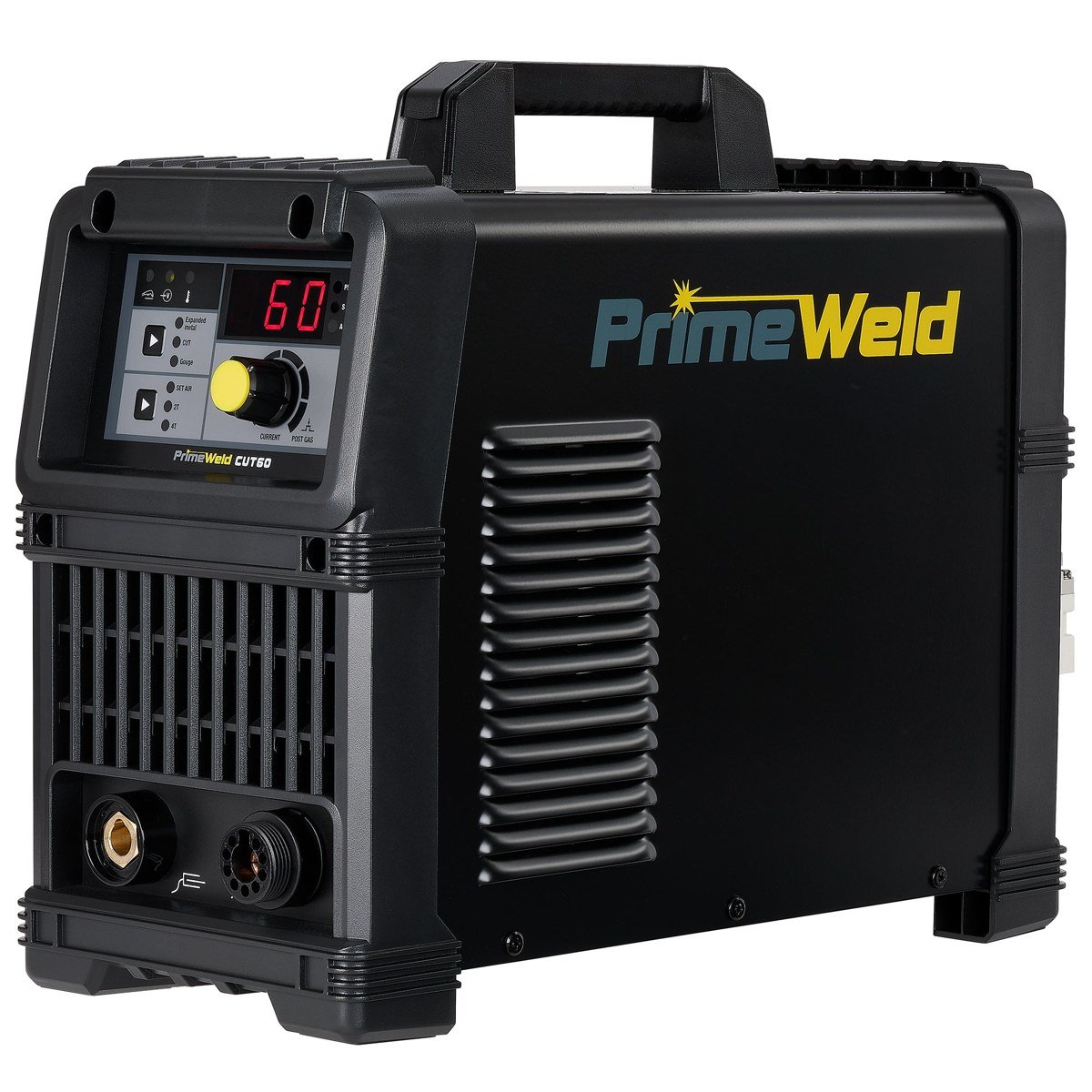
The current CUT60 makes the most sense when the shop already has a 240-volt circuit and a compressor that can continuously supply its stated 5 CFM at 90 PSI. PrimeWeld lists 20 to 60 amps on 240V, compared with 20 to 30 amps on 120V, so 120V operation leaves much of the machine’s output unused. Circuit capacity still matters at either voltage. Its 60 percent duty-cycle claim at maximum output is attractive for longer home-fabrication sessions, and the product is positioned for both manual and CNC use.
PrimeWeld’s current material refers to a new PT60 torch, while package details also identify an IPT60. Confirm the torch, connector, consumables, and CNC interface. Older CUT60 owners on Reddit praise value and support, but those reports may describe a prior generation.
Benefit: Strong output, a three-year warranty, and a plausible path toward hobby CNC without starting at premium-brand pricing.
Caveat: At a checked price of $699, it stops being inexpensive once a compressor, dryer, 240V circuit, and model-specific consumables are added.
Search Amazon for the exact PrimeWeld CUT60 model and verify that the listing matches the current torch and control configuration.
LOTOS LTP5505D: best for occasional cutting on a tight budget
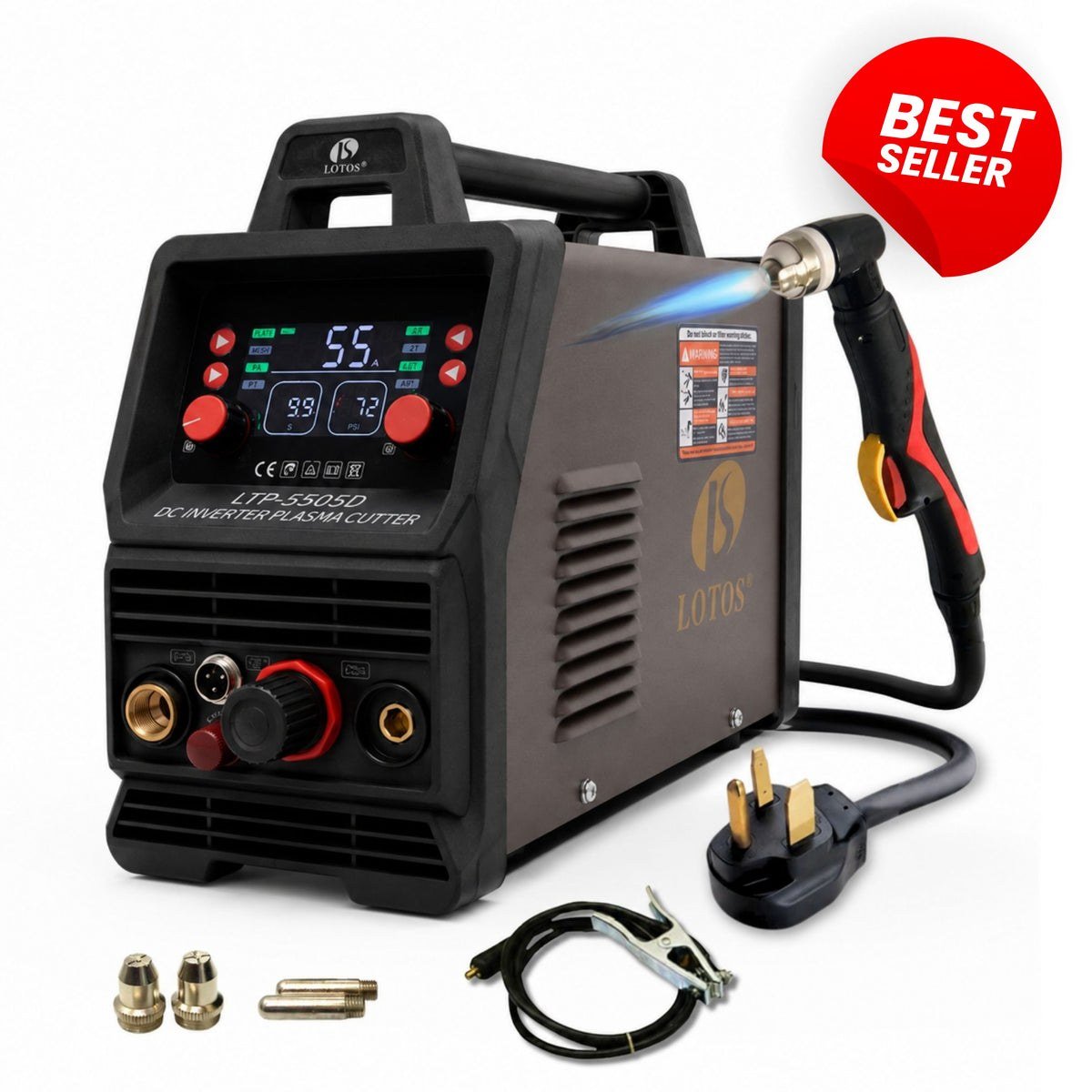
At a checked manufacturer price of $249.98, the LTP5505D is the lowest-cost machine in this group. LOTOS specifies 20 to 35 amps on 120V and 20 to 55 amps on 240V. The retail page promotes a 5/8-inch ideal clean cut on 240V. Its 120V guidance conflicts: the retail page claims 3/8 inch, while the current manual marks 3/8 inch unsupported. Do not plan around 3/8-inch cutting on 120V without confirmation from LOTOS.
Most Reddit history concerns the older LTP5000D. Those owners report useful home-shop service, but also illustrate how an undersized compressor forces pauses. Treat that feedback as evidence about the budget-Lotos ownership proposition, not proof of LTP5505D reliability. LOTOS advertises a three-year limited warranty, with a one-year replacement provision tied to registration, so read the current terms before purchase.
Benefit: A low entry price and meaningful capability on 240V.
Caveat: The replacement model has less independent long-term evidence than its predecessor, and its real total cost still includes adequate dry air.
Search Amazon for the exact LOTOS LTP5505D, since older LTP5000D listings and reviews are not interchangeable.
YESWELDER CUT-55DS NHF PLUS: budget non-HF choice
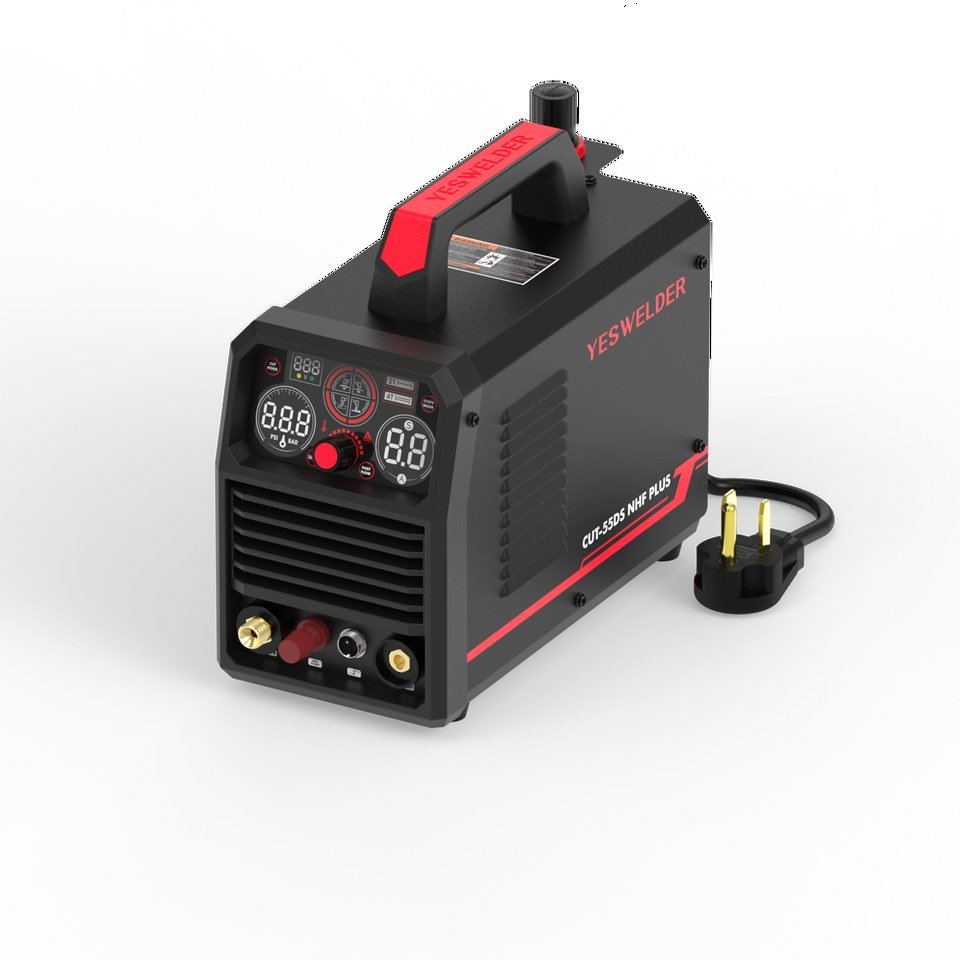
The CUT-55DS NHF PLUS is the option to examine when non-high-frequency starting is a priority but the budget will not stretch to a professional system. YESWELDER identifies a blowback start and IPT40 torch, with 20 to 35 amps on 110V and 20 to 55 amps on 220V. Published clean-cut capacities are 5/16 inch and 1/2 inch respectively. Its air demand is important: at least 6 CFM, with pressure specified as 50 to 60 PSI on 110V and 55 to 70 PSI on 220V.
The exact name matters. CUT-55DS PRO, CUT-55DS PLUS, and CUT-55DS NHF PLUS discussions are often mixed together, although torch and starting systems can differ. The related Reddit thread reviewed concerns a CUT-55DS PRO torch swap, not this NHF PLUS version. It raises a useful compatibility question but cannot establish this model’s performance. Its two-year retail warranty is useful, but buyers should verify consumable availability first.
Benefit: An affordable non-HF start and a clear published air requirement make it worth comparing for hand cutting.
Caveat: Limited exact-model owner evidence makes this a more speculative purchase than the feature list suggests.
Search Amazon for the exact CUT-55DS NHF PLUS and confirm “NHF,” IPT40, and blowback start in the listing.
Hypertherm Powermax30 AIR: premium portable pick
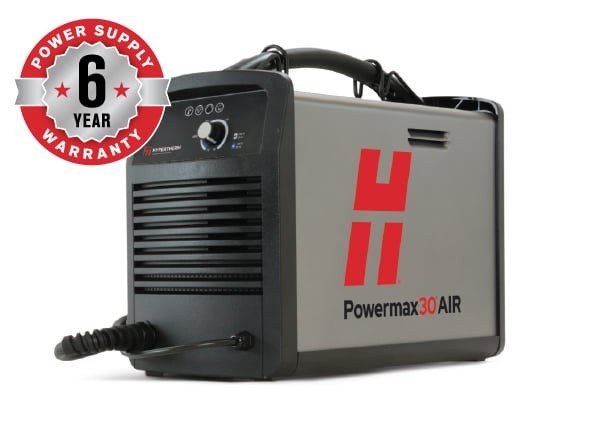
The Powermax30 AIR removes the need to buy an external compressor. A Welder Supply listing showed $2,209.90 during research and offered a stock notification, so confirm both price and availability. Its internal compressor makes it a compact one-box choice for mobile repairs, crowded garages, and shops where external air is wet or unavailable. Hypertherm publishes a recommended 5/16-inch capacity at 20 inches per minute, 3/8 inch at 10 inches per minute, and a 5/8-inch severance at 5 inches per minute. On 120V, maximum recommended output drops to 20 amps.
This is the clearest exact-model owner story in the group. Reddit owners describe several years of reliable service and particularly value portability, although anecdotes cannot establish a failure rate. The tradeoffs are real: at 40°C, Hypertherm lists 35 percent duty cycle on 240V and 20 percent on 120V. The product page lists six years for the power supply and one year for the torch, subject to current warranty terms.
Benefit: Professional documentation and built-in air make setup simple and travel practical.
Caveat: It is expensive for its cutting capacity and is not the natural choice for a future CNC table.
Search Amazon for the exact Powermax30 AIR, not the Powermax30 XP, which requires external air.
What the complete setup costs
An external-air cutter may require a compressor upgrade, regulator, dryer, hose, fittings, consumables, and a suitable circuit. A larger tank extends the time before pressure falls, but does not change the pump’s continuous output. Compare CFM at the required pressure with the cutter’s demand.
Hypertherm’s air-filtration guidance explains that contaminated air affects cut quality and consumable life. A separator can help, while humid shops or frequent use may justify better drying. The Powermax30 AIR avoids this air-supply shopping list, narrowing part of its price gap.
Add personal protective equipment before the first cut. Our guide to building a welding safety kit covers the basics. Check consumable prices for the exact torch, not merely the machine brand.
Match the cutter to the project
For smoker plate and repeated 1/4-inch fabrication, 240V power and steady air matter more than portability. The CUT60 offers the most headroom. A 30 AIR buyer is paying for mobility and simplicity rather than production rate.
For automotive brackets, tabs, and repair patches, all four can be reasonable. A clean ground, correct consumables, dry air, and a guide strongly affect results. New fabricators can start with a first welding project that teaches fit-up.
For ornamental shapes or future CNC use, non-HF starting reduces interference concerns but does not alone make a cutter CNC-ready. Verify triggering, divided-voltage output, machine-torch compatibility, and torch-height-control requirements.
What home-shop buyers and owners keep asking
Across the Reddit threads reviewed, buyers ask whether a small compressor can sustain a long cut, whether 120V is enough, whether consumables will remain available, how warranty service works, and whether high-frequency starting will disrupt CNC electronics.
Budget owners often report satisfactory occasional use when paired with good air. Premium-machine advocates focus on documentation, service, and downtime. Several PrimeWeld owners highlight responsive support, while the Powermax30 AIR owners reviewed emphasize longevity and portability. These are anecdotes, not reliability statistics.
Older posts need careful labeling. LTP5000D experience does not establish LTP5505D performance. Prior CUT60 praise may describe another generation. Similar YESWELDER names can conceal different torches and start methods. In this small research sample, the 30 AIR has the most directly applicable long-running owner reports.
Frequently asked questions
Can I run a plasma cutter from a normal 120V outlet?
Only if the circuit meets the exact machine’s requirements. A dual-voltage label does not mean full rated 120V operation is available from a standard 15A or 20A receptacle. Check the current manual and have an electrician assess any required circuit work; 120V operation also reduces available output.
How large should the compressor be?
Match its continuous delivery at the cutter’s working pressure, then leave practical headroom. Tank gallons alone are not a performance rating. The current CUT60 calls for 5 CFM at 90 PSI, and the YESWELDER calls for at least 6 CFM at its specified pressure range. The Powermax30 AIR supplies its own cutting air.
Do I really need an air dryer?
You need clean, dry, oil-free air. The appropriate treatment depends on humidity, compressor design, hose layout, and use. At minimum, plan for moisture separation and drainage. Frequent cutting in a humid climate may justify a more capable drying system.
Is severance capacity the same as a clean-cut rating?
No. Severance means the machine can separate the material under stated conditions. The cut is slower and may require more cleanup. Compare recommended or ideal clean capacity and cut speed for normal work. This is why this guide does not turn PrimeWeld’s inconsistent current thickness wording into a clean-cut claim.
Which cutter is best if I may add CNC later?
The CUT60 is the most logical starting point here, provided the exact current package exposes the necessary CNC connections and supports the intended torch. The YESWELDER’s non-HF blowback start is promising, but connection and machine-torch details still need verification. The 30 AIR is designed around portable hand cutting.
Is YESWELDER generally a good budget brand?
It can suit hobby buyers who accept a shorter evidence trail and verify support and consumables. Our YESWELDER MIG-205DS PRO review covers another machine but illustrates why the exact model matters.
Final verdict
Choose the PrimeWeld CUT60 for the best blend of output, warranty, and expansion potential in a shop that already has 240V power and strong dry air. Choose the LOTOS LTP5505D when purchase price dominates and cutting is occasional. Choose the YESWELDER CUT-55DS NHF PLUS when inexpensive non-HF starting matters enough to accept limited exact-model owner history. Choose the Hypertherm Powermax30 AIR when portability, built-in air, documentation, and support justify paying much more for moderate cutting capacity.
Research sources
- PrimeWeld CUT60 product page
- PrimeWeld manuals and product documentation
- PrimeWeld guide to dry plasma-cutting air
- PrimeWeld CUT60 torch consumables
- LOTOS LTP5505D product page
- LOTOS LTP5505D current manual
- LOTOS manuals and documentation
- YESWELDER CUT-55DS NHF PLUS product page
- YESWELDER compressor-selection guide
- YESWELDER plasma-cutter comparison
- Hypertherm Powermax30 AIR product page
- Hypertherm Powermax30 AIR support and specifications
- Hypertherm Powermax system comparison
- Reddit: PrimeWeld CUT60 owner and support discussion, 2024
- Reddit: PrimeWeld owner discussion, 2022
- Reddit: Powermax30 AIR owner reports, 2022
- Reddit: Powermax30 AIR hobby-use discussion, 2020
- Reddit: LTP5000D gate project and compressor limitation, 2024
- Reddit: CUT-55DS PRO torch-compatibility question, 2025
- Reddit: compressor requirements and continuous flow, 2022
This article is based on manufacturer documentation, current product pages, and owner discussions. The author did not conduct hands-on comparative testing of these four machines.